Showing posts with label ancient aliens. Show all posts

Tuesday, July 23, 2013

The Ancient Adena


The Landing of Christopher Columbus
courtesy of Wikimedia Commons
Back in the days of yellow number 2 pencils and 3-ringed binders filled with lined paper, American history started with "and then Christopher Columbus North America and it's inhabitance the Indians." Late years, when colored gel pens were allowed, American history got a little more specific, detailing that there were in fact many different tribes of Native Americans inhabiting North America.  All in all, it was little more than a list of tribes and the regions they inhabited. We were taught long houses were different from tee-pees and that thanks to the "white man" Native Americans now had horses and other civilized commodities.

via Wikipedia
I never was one for American History partly because there was no real meat to it prior to the pilgrims landing and eking out a life in the Northeast.  South America provided a much livelier scene with Maya, Incas, and Aztecs creating sophisticated cultures which spanned thousands of miles and charted the starts with incredible accuracy.  Having graduated from college several years ago, still with the same primitive picture of early Native American life that had been shoved down my throat since I dress up like an Indian for the kindergarden school play, I was surprised to stumble over the book Advanced Civilizations of Prehistoric America by Frank Joseph.  I had stumbled over Native American groups such as the Hopewell and the Anasazi but was completely unaware of an entire extinct culture known as the Adena.

The Adena, who existed from 1000BC to 700AD, "showed no signs of development but appeared full-blown around 1000BC" (pg. 15, Joseph).  Though Wikipedia shows them as remaining within the state of Ohio, Joseph's work attributes buildings to the late culture spanning from Wisconsin to West Virginia.  Though signs of mound builders are evident throughout those areas, what was interesting about this group was the first story that Joseph shared about lost pyramids at the bottom of Rock Lake, Wisconsin.  Set under 60ft of water, these pyramids aren't exactly like what you would find on the Gaza plateau or in the jungle of the Yucatan nor do they resemble the earthen mounds found in the Ohio Valley.
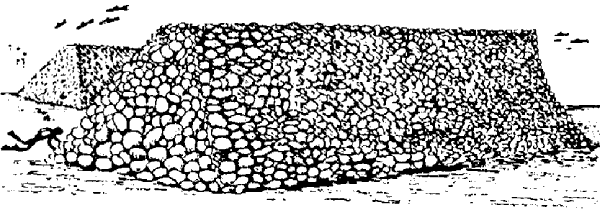
Lost pyramids of Rock Lake, Wisconsin
via science-frontiers.com

Modified Adena Skull
via "Frontiers of Antrhropology"
I must confess that I did not read the entire book, choosing to allot my time to just the sections on the Adena. Owing to this I can not pass a verdict on whether the rest of the book was as enlightening as its opening chapters.  The introduction to the Adena has led me to research further on this interesting people who seem to have had quite a complex trading network in place and who were very skilled in both pottery and metallurgy.  My searches have also lead to the curious fact that most Adena skeletons found tend to be well over 6ft tall and there have event been some reports of finding remains of 7ft and taller giants in the area as well.

It amazes me that in our 200 years of existence, the US is finally turning it's attention on learning about the incredible cultures that inhabited these land prior to arrival of the Europeans.  Whether it was the lack of interest or the need to feel superior, I hope that others like Mr. Joseph will continue to pry into the true history of North America.

Monday, July 8, 2013

Stone Spheres

Image from www.bosnian-pyramid.org
Stone Spheres have been found in many parts of the world ranging from the initial discovery in the 1930's in the river delta of the river Diquis, Costa Rica to the valleys of Bosnia.  Most of the sphere have been found to be nearly perfectly round and most are made of hard stone known as granodiorite.

Unlike the great pyramids of the ancient Mayans and Egyptians or the vast temple complexes of the ancient Indians, these comparatively small feats are just as worthy of our attention.  It is their simplicity that evokes awe and wonder.  How could ancient man whose main concern was most likely sustenance and reproduction develop the ability to create a nearly perfect sphere out of hard stone?  And out of all the more malleable stones available, why choose the one with a heightened magnetic field?  

According to Nenad Djurdjevic, author of Bosnian Stone Spheres Revisited, the stones spheres made from "granodiorite contains dominant magnetic minerals, while experiments in Physics have demonstrated that the magnetic field strength inside the spherical object is approximately three times that of the externally applied field. In other words, the magnetic field is amplified inside the sphere."
Image from Google Images

Excited by the idea of these strangely magnetic stones found around the world I decided to see if these particular points on the globe were connected in any way.  

My first experiment took me back to childhood, where like most children who embark on the task of digging a large hole in the sand are told if they keeping going they will "dig their way to China!" [Being in America, I've found that China is the most popular destination for tunnel-though-the-center-of-the-Earth explorers]. Much to my disappointment what lay on the other side of the Earth from the Disquis delta was not the valleys of Bosnia but rather the Indian Ocean near Malaysia. For Bosnia, the South Pacific near New Zealand.  This free tunneling tool showed me that much of what lay on the other side of the world is water, NW and Southern South America being the exception [Apparently you have to start in Argentina if you wish to dig your way to China].


My next experiment was to see if the spots lined up with any of the world grid theory lines.  Sure enough the first map I pulled, "Planetary Grid System: by Becker-Hagens (c)1983 showed both spots directly under a grid line!  Granted, this image doesn't posses the best of resolutions but it was enough to see that both areas lay close to the lines.  I do not possess to be an expert in the planetary grid system or the World Grid Theory but I know just enough to get my little imagination going.

What if the stones, using their amplified magnetic powers were devises used to
This is not building plans
for the Death Star!
Image of World Energetic
Grid Theory
transport objects, maybe even humans? Perhaps if the stones were aligned in a specific formation their powers were harnessed. Like many ancients sites who's arrangement seems arbitrary till scrutinized carefully, perhaps the sphere were aligned perfectly, ready for use before modern man came and carted them off for research or display. Or l
ike most civilizations who are invaded or fall into disarray, the secret of their power was purposely lost by moving the stones to break the connect. 

Without written documentation regarding their true use from the cultures who built these impressive sphere, my intellectual wanderings will remain just that...wanderings.

Saturday, June 15, 2013

Chachapoya

Image property of History Channel
Having made a wonderful dinner, most of which came from my garden, my husband and I sat down for our evening meal.  Tonights special: History's Mysteries: Cliff Mummies of the Andes.

A year and a half ago, my husband and I trekked four days along the Incan trail to Machu Picchu.  Prior to this trip the only history of the area that I knew was of the Incas.  Being an Art History major with a specialty in "non-western" art, I am ashamed to say as I watched the documentary that the Chachapoya were a people completely unknown to me.  The majority of the film follows Dr. Keith Muscutt of the University of CA, Santa Cruz on his 15 year quest to find an undisturbed Chachapoya burial site.


Tombs in the Cliff "Diablo Huasi"
(©Adriana von Hagen)
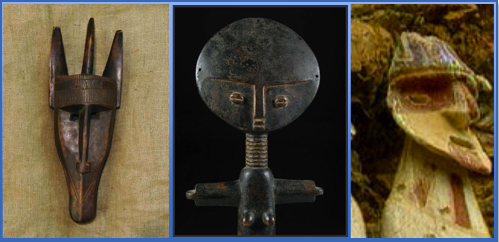
The documentary itself was well done but what drove me to choose the documentary was the cover image.  The stone figures painted with decorative red designs reminded me of an art exhibit that I was fortunate enough to help renovate.  The exhibit was a revamping of African art installation, mostly pieces belonging to the Dogon and surrounding north african people. The pieces which connected for me were on of the Dogon masks and an Akuaba doll.

Dogon Mask (source: GenuineAfrica.com),
Ashanti Akuba Doll (source: randafricanart.com),
Chachapoya funeral guard (source: HistoryChannel.com) 


The high broad forehead, thin straight nose and oval eyes can be found on all three statues.  For the woman who commissioned the Akuba dolls, these traits represented their ideal beauty.  Since the Akuba dolls were used by woman as a sort of fertility charm, it's only fitting that the image would represent the ideal beauty.  What I find interesting, and why I've compared the Chachapoya statue to African statues is that typical Incan humanoid statues do not share these physical traits.


Statue from "1000
Years of Incan Gold"
Source: silviahartmann.com

Pre-Incan statue @ San Augstin
Archeological Park
Source: posterlounge.co.uk
Though the Chachapoya were conquered by the Inca and not Incan themselves, the Inca's influence would have been evident in their art.  Incan faces tend to have much larger eyes, a triangular/broad nose and ornamentation in the form of a hat, earrings and/or necklace.  

Why would a culture, such as the Chachapoya, develop such a different artistic style from the cultures that surrounded it. And why would their style emulate culture which were thousands of miles away?  I don't have an answer just a series of theories, one of which includes ancient air travel.  Not probable I realize but it would definitely help to explain occurrences such as these.